
Helium 10 Market Tracker is the part of Helium 10 that helps you monitor a product niche over time instead of checking one keyword or one ASIN in isolation. It is most useful when you want to track competitor movement, estimate market share, and see whether a market is growing, flattening, or getting more crowded. For most small and mid-sized sellers, standard Market Tracker is enough. Market Tracker 360 only makes sense when you need broader market coverage and deeper share-of-voice style analysis.
| Best for | Sellers tracking a niche over time |
| Main job | Monitor competitor movement, trend shifts, and estimated market share |
| What it tracks well | Market-level changes, leading products, revenue trends, review velocity, and category movement |
| What it does not replace | Product discovery tools like Black Box or keyword tools like Cerebro |
| When standard is enough | You want a clean market dashboard for one niche or product set |
| When to consider 360 | You manage a larger brand, agency workflow, or broader market set |
| Best for | Not ideal for |
|---|---|
| Sellers who already know their niche and want recurring market monitoring | Sellers still doing broad product discovery |
| Teams comparing their product against direct competitors | Anyone who only needs one-off keyword research |
| Operators watching market share and trend direction over time | Anyone expecting exact Amazon-first-party market truth |
What Is Helium 10 Market Tracker?
Market Tracker is Helium 10’s niche-monitoring tool. You build a market by adding the products that actually compete with yours, and Helium 10 then tracks how that market changes over time. That makes it different from Black Box, which helps with discovery, and different from Cerebro or keyword tools, which help you understand search demand.
The practical value is not that it gives you perfect truth. The value is that it gives you a repeatable way to watch the same market set over time, so you can spot trend changes, new entrants, review acceleration, and share shifts faster than you could by checking product pages manually.
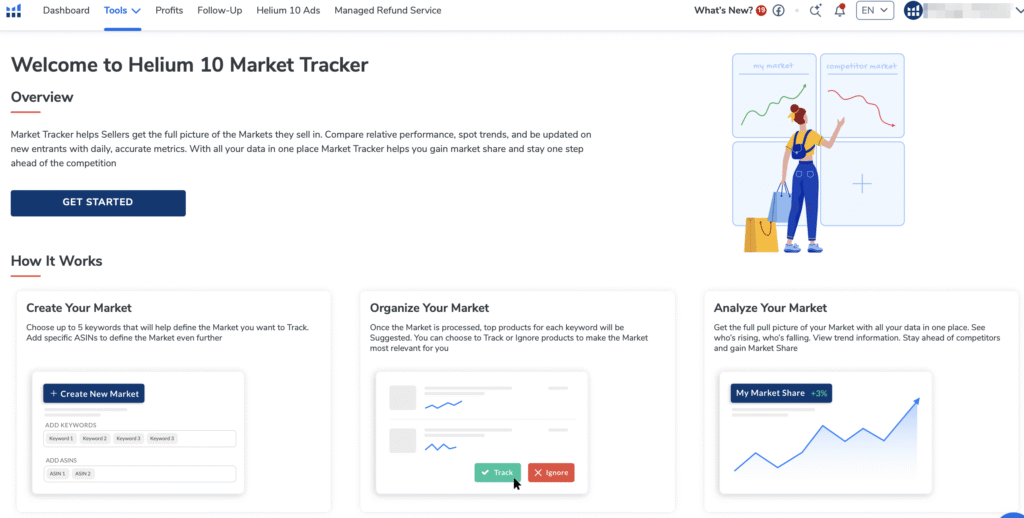
What Market Tracker Actually Shows
- Estimated market share so you can see which products dominate the niche
- Sales and revenue trend direction across the products in your tracked market
- Competitor movement including products gaining or losing momentum
- Review and pricing shifts that can signal stronger competition or weakening offers
- Market-level trend changes so you can tell whether the niche looks healthier or more crowded over time
Used well, this helps you answer a practical question: is my product just underperforming, or is the whole market changing?
How to Set Up Market Tracker Without Polluting the Data
- Define the niche narrowly. Track direct substitutes, not loosely related products.
- Use comparable price tiers. Mixing budget and premium products can distort the read.
- Check suggested ASINs manually. Do not accept every recommendation blindly.
- Exclude odd bundle types. Bundles, packs, or accessory-heavy offers can make the market look larger or stranger than it really is.
- Refresh the market set when the category changes. A good market definition is not permanent.
The quality of Market Tracker depends heavily on the quality of the market you build. Bad market inputs create bad market conclusions.
Market Tracker vs Market Tracker 360
| Question | Market Tracker | Market Tracker 360 |
|---|---|---|
| Main use case | Track one niche or focused market set | Track broader markets with deeper visibility |
| Best fit | Small and mid-sized sellers | Larger brands, teams, or agencies |
| Complexity | Simpler and easier to operationalize | Better when you need bigger-scope monitoring |
| When it is enough | You already know the competitors you want to watch | You need wider market coverage and more advanced reporting |
| Recommendation | Start here first | Upgrade only if the standard version feels limiting |
For most sellers, the standard version is the right starting point. It is easier to keep clean, easier to interpret, and usually enough to tell whether your niche is moving in the right direction. If you want access-path context, check the current Helium 10 pricing breakdown and the updated guide to the Helium 10 free plan and trial options.
Common Mistakes When Using Market Tracker
- Tracking products that are adjacent rather than directly competitive
- Treating estimates like exact Amazon internal numbers
- Reading one short-term movement as a permanent market shift
- Using Market Tracker without checking product validation in Xray or discovery data in Black Box
- Assuming the biggest market is automatically the best market
Is Helium 10 Market Tracker Worth It?
Yes, if you already sell in a niche and want a repeatable way to monitor competitor movement, market share, and trend direction. It is less compelling if you are still in very early product discovery mode or if you only need keyword research. In that case, Cerebro, Xray, or Black Box may matter more first.
If you are comparing Helium 10 against broader alternatives instead of only comparing tools inside the suite, start with the flagship guide to the best Amazon seller tools.
FAQ
What does Helium 10 Market Tracker do?
It helps you monitor a chosen product niche over time by tracking competitor movement, market share estimates, and trend direction.
Is Market Tracker included in Helium 10?
Access depends on plan level and current Helium 10 packaging, so it is worth checking the latest pricing page breakdown before assuming every plan includes the same access.
What is the difference between Market Tracker and Market Tracker 360?
Standard Market Tracker is enough for most sellers who want a clean niche-monitoring dashboard. Market Tracker 360 is better when you need broader coverage, larger market sets, or more advanced reporting.
Is Helium 10 Market Tracker accurate?
It is best treated as a directional decision tool, not exact first-party Amazon truth. Its usefulness depends heavily on how well you define the market you track.