SmartScout Listing Visibility Tracking: How SmartScout Measures Visibility Now
Affiliate disclosure: we may earn a commission if you buy through links on this page. How we make money How we check facts
SmartScout’s pricing page doesn’t list a feature called Listing Visibility Tracking (checked 10 October 2026). Listing visibility now shows up in two places: the Product Visibility Score, a 0–100 score that SmartScout says is “tracked historically”, and Rank Maker’s Visibility Score chart, which tracks visibility across every keyword a product ranks for, from August 2024 onward. Both start on Essentials: $99 a month billed yearly or $119 monthly.
Visibility scores start on the Essentials plan · 7-day money-back guarantee Affiliate link
Whether SmartScout as a whole is worth paying for is the job of our SmartScout review. This page covers how SmartScout measures a listing’s visibility today.
Correction (10 October 2026): this page previously said Share of Voice needs the Business plan. It is Enterprise-only: SmartScout’s pricing table ticks it for Enterprise alone, and its Share of Voice page says “Available with the Enterprise plan”. Essentials also no longer costs $97 a month.
What happened to the name
Earlier versions of this page reviewed “Listing Visibility Tracking” as an Essentials feature. SmartScout’s current pricing table and plan cards don’t use that name. The nearest row is the Product Visibility Score, also on Essentials, but we can’t confirm from SmartScout’s public pages that it is the same feature under a new name. So this page covers the visibility measures SmartScout sells now.
SmartScout’s visibility measures, and what each answers
| Measure | What SmartScout says it shows | Plan |
|---|---|---|
| Product Visibility Score | “Scores products out of 100, describing the visibility of a product in aggregated search results. Tracked historically.” | Essentials |
| Visibility Score (in Rank Maker) | “A rolling time-series chart showing how visible your product has been across all ranking keywords over the past 12 to 18 months” | Essentials |
| Keyword Ranking Map | A product’s organic rank for one search term in each US state | Business per the pricing table; SmartScout’s own page says every plan |
| Share of Voice | Each brand’s share of visibility across a keyword set, weekly, organic and paid | Enterprise |
| AI Visibility Monitor | How often AI shopping assistants such as Rufus and ChatGPT mention a product | Every plan (1, 10, 25 or 60 dashboards, by plan) |
Sources: SmartScout’s pricing table and its tooltips, the Rank Maker and Keyword Ranking Map pages, and the features hub, all checked 10 October 2026. SmartScout doesn’t say whether the Product Visibility Score and Rank Maker’s Visibility Score are the same number. Plan prices are on our SmartScout pricing page.
What the Visibility Score looks like
The chart sits in Rank Maker’s product view. On the listing we checked from our complimentary Business account on 2 August 2026, it had two lines, which SmartScout’s Rank Maker page describes as a “Dual-axis view: Visibility Score vs. Search Terms tracked”. The axis is labelled from Jan ‘25 to Jul ‘26, but both lines start around September 2024 and run to the start of August 2026.
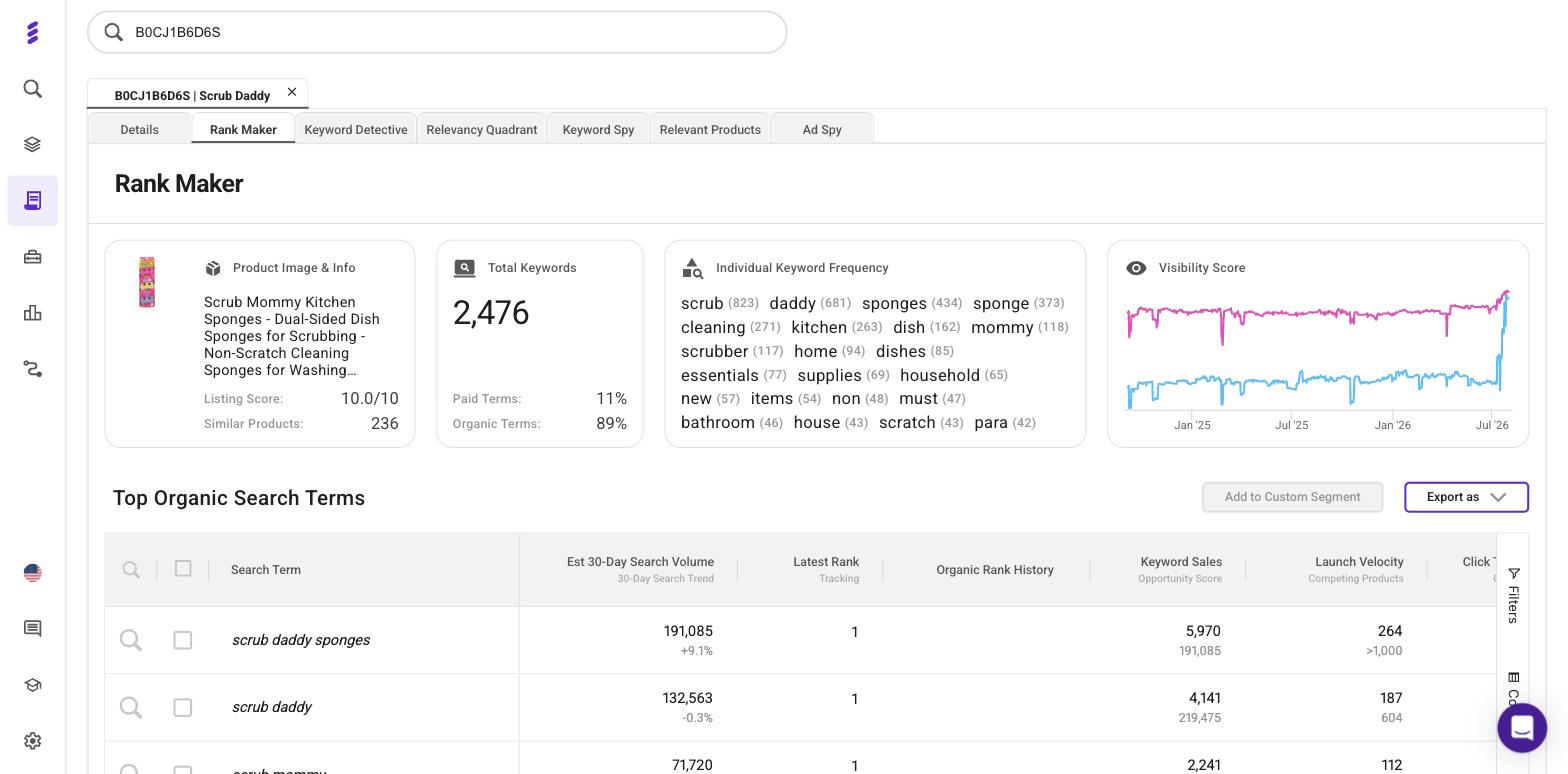
SmartScout says the data starts in August 2024. Its Rank Maker page also advertises “18 Months of Visibility History”, but the chart above covers close to two years. How much a given product shows depends on when it entered SmartScout’s dataset. Our Rank Maker review covers the rest of that screen.
How to read a visibility drop
- Check the trend, not one week. A Visibility Score falling for several weeks matters more than a single dip.
- Find the terms that slipped. Track the keywords that matter in Rank Maker: SmartScout says each tracked keyword gets a rank-history sparkline in the table, which shows whether it moved. A listing can hold its top three terms and still lose visibility across the long tail.
- Check whether it is regional. SmartScout’s Keyword Ranking Map page argues that ranking well in one region and badly in another “is an inventory placement problem, not a listing problem”. The map shows state-by-state rank for one term.
- Check paid pressure. As SmartScout’s own keyword-tracking guide puts it, “competitor ads may still push your product down the page” even when you win the organic term. Ad Spy (a Business add-on, included on Enterprise) shows who holds the sponsored placements.
Visibility, rank and share of voice: three different questions
- Rank: where does my product sit for one keyword? See SmartScout rank tracking.
- Visibility: how visible is my product across all the keywords it ranks for? That is this page.
- Share of voice: of all the visibility on a set of keywords, how much does each brand hold? See Share of Voice, which is Enterprise-only.
What this page is based on
SmartScout’s pricing page, Rank Maker page, Keyword Ranking Map page, features hub and keyword-tracking guide, all checked on 10 October 2026, plus the Rank Maker screenshot from our complimentary Business account (2 August 2026). Our methods are on how we test.
Frequently Asked Questions
Does SmartScout still have Listing Visibility Tracking?
Not under that name. SmartScout's pricing page doesn't list it (checked 10 October 2026). The closest current features are the Product Visibility Score and Rank Maker's Visibility Score chart, both from the Essentials plan.
What is SmartScout's Product Visibility Score?
SmartScout describes it as a proprietary score out of 100 for how visible a product is in aggregated search results, tracked historically. It starts on the Essentials plan, and SmartScout doesn't publish the formula.
How far back does SmartScout's visibility history go?
Back to August 2024 at most. SmartScout's Rank Maker page advertises 18 months of visibility history but says its data runs from August 2024 onward, and the chart we captured on 2 August 2026 went back to around September 2024. How much history a product shows depends on when it entered SmartScout's dataset.
Is listing visibility the same as Share of Voice?
No. Visibility scores describe one product. Share of Voice compares every brand's share of visibility across a keyword set, split into organic and paid, and it is only on SmartScout's Enterprise plan.