SmartScout Share of Voice: What It Measures and Why It Is Enterprise-Only
Affiliate disclosure: we may earn a commission if you buy through links on this page. How we make money How we check facts
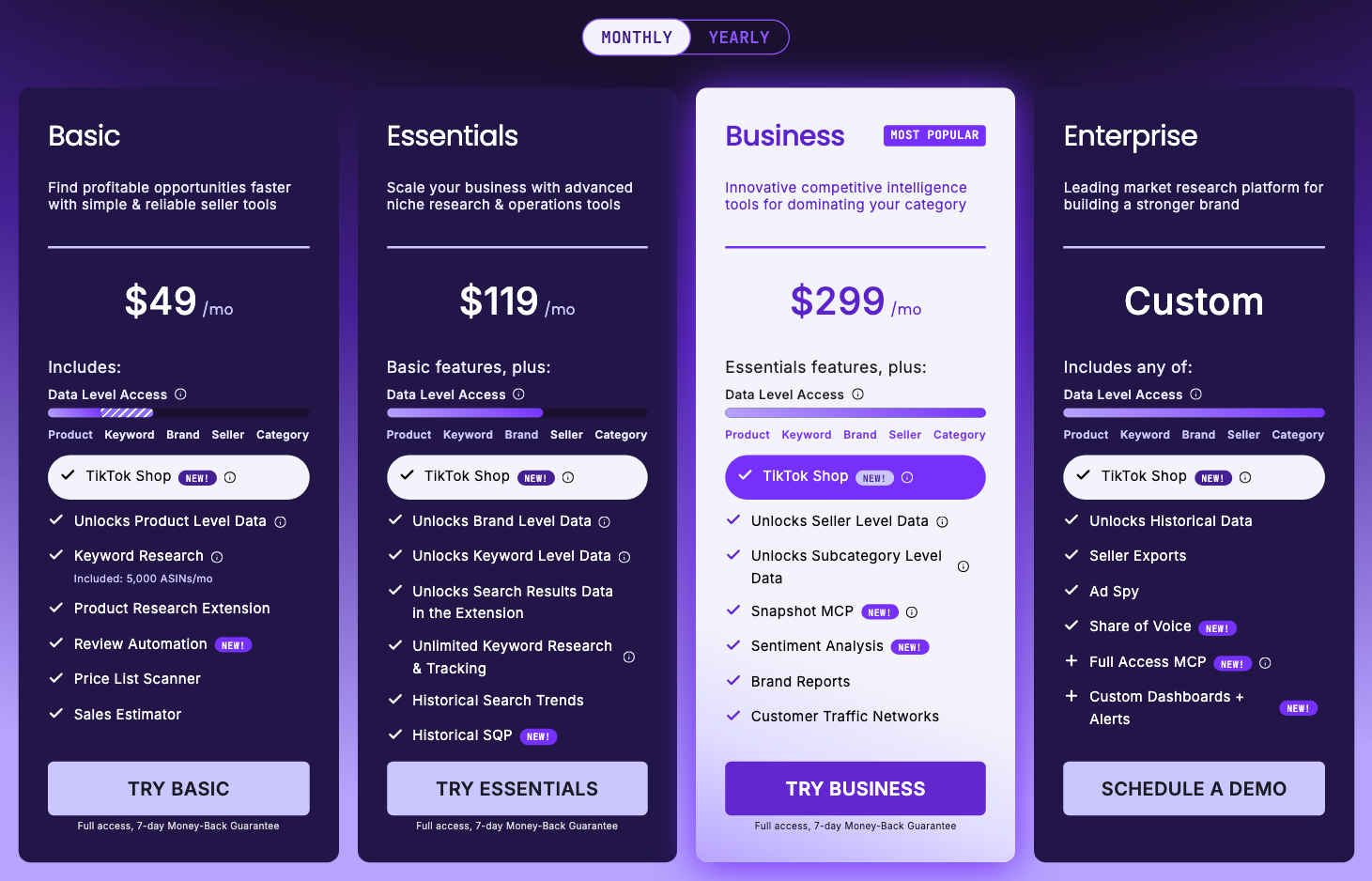
SmartScout’s Share of Voice measures each brand’s share of search visibility across a set of keywords you choose, week by week, split into organic and paid. It is only on the Enterprise plan, which SmartScout prices after a demo. Business, at $239 a month billed yearly or $299 monthly (checked 10 October 2026), doesn’t include it.
Share of Voice is Enterprise-only · priced after a demo Affiliate link
Correction (10 October 2026): pages on this site previously described Share of Voice as a Business-plan feature. That was wrong. SmartScout’s pricing table ticks it for Enterprise alone, in both rows where it appears, and its Share of Voice page says “Available with the Enterprise plan” (both checked 10 October 2026). Whether SmartScout as a whole suits you is covered in our SmartScout review.
What Share of Voice shows
SmartScout’s Share of Voice page (checked 10 October 2026) describes the tool in three steps.
- Pick the keywords. You start from a brand, product, subcategory, custom segment or seed search term. SmartScout suggests relevant keywords with their estimated 30-day search volume, the top competitor on each term and its traffic share, total keyword sales and your own brand’s traffic share. Terms you select collect in a “Search Terms Bank”.
- Read the chart. Each brand’s share is trended weekly or monthly, with four views: Overall SOV (organic and paid weighted together), Organic Traffic, Paid Traffic and Product Ad Spend. Each view works at brand or product (ASIN) level.
- Read the table. Every brand competing on your term set is listed with its share of voice and recent change, product count on the terms, paid and organic split, average price, top search position, monthly revenue and country of origin.
Clicking a brand opens an overlay that plots its visibility against its advertising, with spend broken out by Sponsored Brand, Sponsored Video, Top Group and Top Spot. SmartScout says Share of Voice is computed weekly, and that the table and trend data can be exported.
SmartScout’s own pitch for it is “Rank Trackers Answer the Wrong Question”: a rank tracker tells you where one ASIN sits on one keyword, while Share of Voice tells you how much of a category’s search demand each brand captures, and which way that is moving.
How SmartScout estimates the paid side
The Product Ad Spend view and the overlay put a dollar figure on competitors’ advertising, so it matters where that figure comes from. SmartScout’s own guide to share-of-voice tools says it “models CTR by placement, then combines keyword search volume, placement win rates, and estimated CPC to produce directional competitive ad spend”. The same guide says SmartScout tracks “more than 2 million Amazon keywords with a 24-month history”.
Directional is SmartScout’s word, and the right one. Its own Ad Spy page notes that “Amazon does not publish exact ad spend”, so these are estimates built on other estimates. Use them to compare brands and spot shifts, not to quote a rival’s budget.
Which plan includes Share of Voice
| Plan | Price (checked 10 October 2026) | Share of Voice |
|---|---|---|
| Basic | $29/mo billed yearly, $49 billed monthly | No |
| Essentials | $99/mo billed yearly, $119 billed monthly | No |
| Business | $239/mo billed yearly, $299 billed monthly | No |
| Enterprise | Custom, quoted after a demo | Yes |
Share of Voice appears twice in SmartScout’s plan comparison: under Market and Competitor Research, and again under “Historical Data via Scope”, where the tooltip reads “Historical share of voice for any search term”. Both rows are ticked for Enterprise only. The Enterprise card lists it under “Includes any of:”, so check that it is in your package before you sign. The other plans are compared on our SmartScout pricing page.
Who it is for, and who should skip it
SmartScout pitches it at channel owners reporting share of search, executives who want one category chart, category analysts, and brand-protection teams watching who bids on their brand name. That matches what the tool does: it is a brand-level reporting view across many keywords.
It is the wrong buy for a seller with a handful of ASINs. You would be paying for Enterprise to learn things that cheaper SmartScout tools already approximate:
| What you want to know | Cheaper SmartScout option | Plan |
|---|---|---|
| Is my product’s visibility rising or falling? | Rank Maker’s Visibility Score (see listing visibility) | Essentials |
| Where does my listing rank, term by term? | Rank tracking in Rank Maker | Essentials |
| How does my top product compare with a rival’s? | Brand Reports (Competitor Analysis) | Business |
| Which brands hold sponsored placements on my terms? | Ad Spy | Business add-on, or Enterprise |
None of them gives each brand’s share across a keyword set over time. If that number is what your reporting needs, Share of Voice is the SmartScout tool built for it. For competitor and category tracking outside SmartScout, our Amazon market intelligence tools guide compares SmartScout with four other tools.
What we can’t tell you
- How accurate it is. SmartScout doesn’t publish an accuracy figure for it.
- How Overall SOV weights organic against paid. SmartScout calls it “a weighted blend” without giving the weights.
- What Enterprise costs. SmartScout publishes no Enterprise price.
What this page is based on
SmartScout’s Share of Voice page, its pricing page, its Ad Spy page and its guide to share-of-voice tools, all checked on 10 October 2026. Our complimentary SmartScout account is on Business, so we can’t open Share of Voice, and nothing on this page comes from using it. Our methods are on how we test.
Frequently Asked Questions
Which SmartScout plan includes Share of Voice?
Only Enterprise. SmartScout's pricing table ticks both of its Share of Voice rows for Enterprise alone, and its Share of Voice page says the feature is available with the Enterprise plan (checked 10 October 2026). Enterprise is priced after a demo.
What does SmartScout Share of Voice measure?
Each brand's share of search visibility across a set of keywords you choose, computed weekly and split into organic and paid. It also shows estimated ad spend behind the paid share, broken out by placement.
Are SmartScout's competitor ad spend figures exact?
No. SmartScout says it models click-through rates by placement and combines search volume, placement win rates and estimated cost per click to produce directional ad spend figures. Its own Ad Spy page notes that Amazon does not publish exact ad spend.
Is there a cheaper way to track visibility in SmartScout?
For a single product, yes. Rank Maker's Visibility Score and rank tracking start on Essentials, at $99 a month billed yearly or $119 monthly (checked 10 October 2026). None of the cheaper tools shows each brand's share across a keyword set.
Is Share of Voice the same as a rank tracker?
No. A rank tracker shows where one product sits on one keyword. Share of Voice rolls visibility up to brand level across many keywords and shows how each brand's share moves over time.