SmartScout Rank Tracker: “Unlimited” Keyword Tracking Inside Rank Maker
Affiliate disclosure: we may earn a commission if you buy through links on this page. How we make money How we check facts
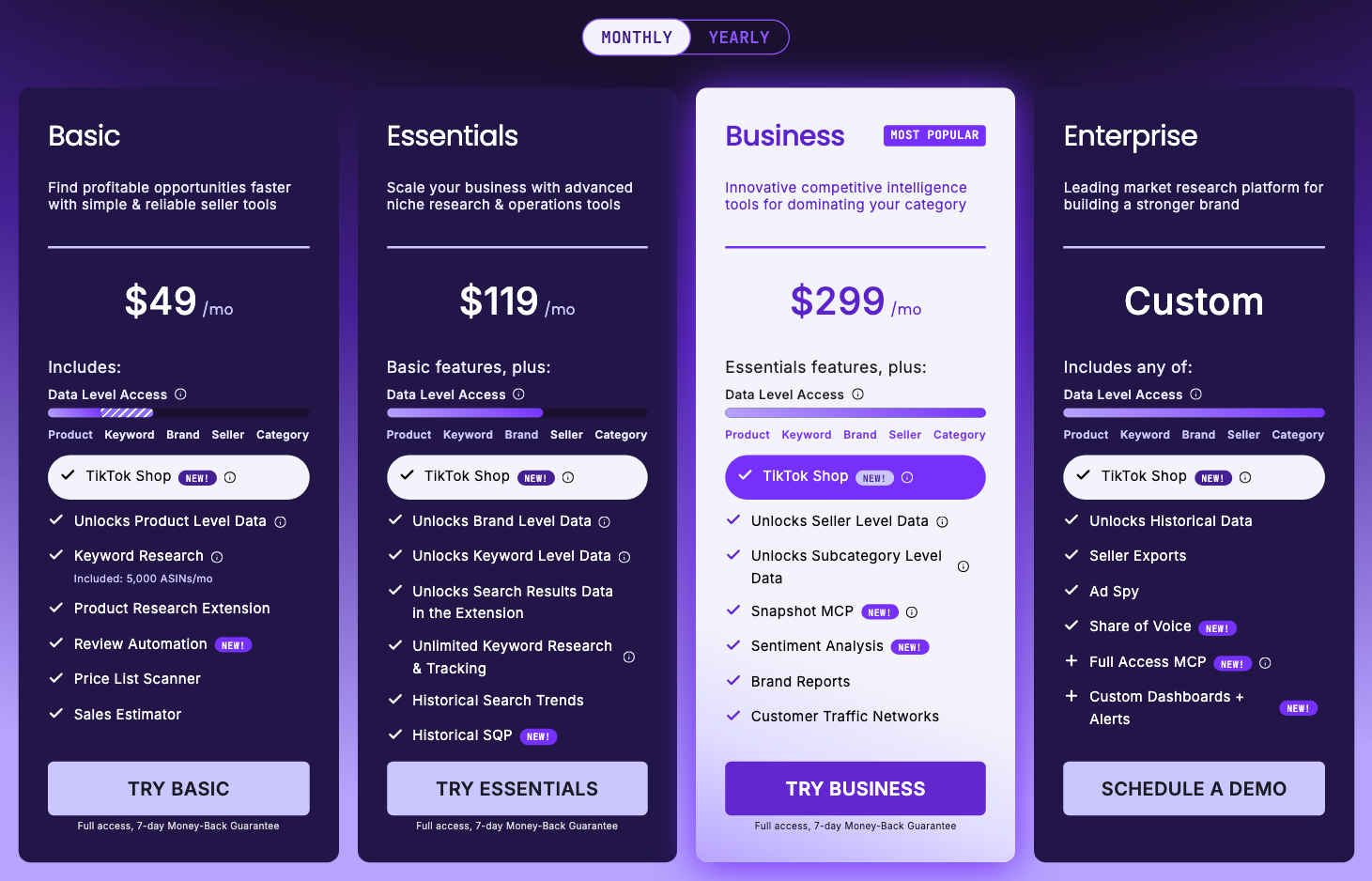
SmartScout’s keyword rank tracking now lives inside Rank Maker; its old /rank-tracker page redirects there. SmartScout says you can “track unlimited keywords with no caps or throttling”, each with a rank-history sparkline. Tracking starts on Essentials, at $99 a month billed yearly or $119 monthly (checked 10 October 2026). Basic doesn’t include it.
Rank tracking starts on the Essentials plan · 7-day money-back guarantee Affiliate link
This page is for the seller who already knows which keywords to watch. If you haven’t settled on SmartScout itself, start with our SmartScout review.
Correction (10 October 2026): this page previously described SmartScout Rank Tracker as a page separate from Rank Maker, and Essentials as $97 a month. SmartScout’s /rank-tracker address no longer has its own page (it redirects to Rank Maker), and Essentials now costs $99 a month billed yearly or $119 monthly.
How rank tracking works in SmartScout now
Three sources describe it: two SmartScout pages, checked 10 October 2026, and our own account.
- The Rank Maker page lists Rank Tracking as one of Rank Maker’s six parts: “Toggle on tracking for any keyword and monitor your rank position over time. Every tracked keyword gets a sparkline history chart right in the table.”
- The Essentials plan card lists “Unlimited Keyword Research & Tracking”, with the tooltip “Via Search Terms Explorer and Rank Maker.”
- Our own account: in the Rank Maker table on our complimentary Business account, the Latest Rank column carries a “Tracking” label, next to an Organic Rank History column. That column was empty for the rows in our 2 August 2026 capture; SmartScout says every tracked keyword gets a sparkline there. The screenshot is on our Rank Maker review.
So you track from inside the keyword list: find the term in Rank Maker and switch tracking on, and SmartScout says its rank history then builds in the same table. Because Rank Maker works on any ASIN, the same applies to a competitor’s listing.
Two related views sit next to it:
- The Visibility Score, a chart of how visible a product has been across all its ranking keywords, from data that SmartScout says starts in August 2024. Our listing visibility page covers it.
- Ad metrics. With an Amazon Advertising account connected, ROAS, ACOS, CTR and CVR appear next to organic rank.
How SmartScout compares with other Amazon rank tracking tools
| Tool | Keyword rank tracking | Plan it starts on |
|---|---|---|
| SmartScout (Rank Maker) | “Unlimited”, per SmartScout | Essentials |
| Helium 10 | Included on Diamond, no count shown; on Platinum, the Keyword tracker is an add-on from $19/mo | Diamond, or Platinum with the add-on |
| Jungle Scout | Rank Tracker: 500 keywords on Growth Accelerator, 5,000 on Brand Owner, none on Starter | Growth Accelerator |
| Data Dive | Rank Radar: 25, 1,000 or 12,000 keywords, depending on plan | Starter |
Limits are from each vendor’s pricing page, as recorded in our checks on 10 October 2026. SmartScout’s plans are compared on our SmartScout pricing page, and the others on our Helium 10 pricing, Jungle Scout pricing and Data Dive pricing pages.
Unlimited tracking is the headline difference. Jungle Scout and Data Dive publish keyword caps by plan, and Helium 10 shows no count for Diamond but sells Platinum users tracking as an add-on; SmartScout says it has no cap at all.
The Keyword Ranking Map: rank by US state
SmartScout’s Keyword Ranking Map answers a question a single national rank hides; its page opens with “One Keyword Can Rank #3 in Texas and #27 in Maine.” You enter an ASIN and a search term, and SmartScout samples the organic rank from a representative zip code in each state, paints it on a map and lists it in a table you can export to Excel. It covers US states only, each check draws from a monthly allotment, and a force-refresh button pulls a live reading (all per SmartScout’s page, checked 10 October 2026).
The plan is unclear. The Keyword Ranking Map page says “Included with every plan”. SmartScout’s pricing table has a “Keyword Map” row, with the tooltip “See exactly how your products rank for a keyword across the United States”, ticked only for Business and Enterprise. Ask SmartScout before you buy a cheaper plan for it.
When SmartScout’s tracker is the right choice
- You want to track hundreds or thousands of terms without counting slots. That is the clearest advantage over the metered trackers above.
- You already need Essentials for Rank Maker, Search Terms Details or Search Trends, so tracking comes with it.
- You track competitors as well as yourself, since Rank Maker works on any ASIN.
When it isn’t
- Tracking a short keyword list is the whole job. Data Dive’s Starter plan, at $39 a month or $32 billed yearly with 25 Rank Radar keywords, costs less than SmartScout Essentials.
- You need to know how often ranks refresh. SmartScout’s Rank Maker and Keyword Ranking Map pages don’t say how often tracked ranks update; its features hub says only that its tools run on a data set “refreshed continuously”, and its help center wouldn’t load when we checked on 10 October 2026. If you are watching a launch day by day, ask SmartScout before you rely on it.
- You need regional ranks outside the US. The Keyword Ranking Map covers US states only.
What this page is based on
SmartScout’s Rank Maker page, Keyword Ranking Map page, features hub and pricing page (plan cards, comparison table and tooltips), and the other vendors’ pricing pages, all checked on 10 October 2026, plus the Rank Maker screenshot from our complimentary Business account (2 August 2026). Our methods are on how we test.
Frequently Asked Questions
Does SmartScout have a rank tracker?
Yes, but not as a separate tool. Rank tracking is part of Rank Maker: you switch tracking on for any keyword in Rank Maker's table, and SmartScout's old /rank-tracker address redirects to the Rank Maker page (checked 10 October 2026).
How many keywords can SmartScout track?
SmartScout says Rank Maker tracks unlimited keywords with no caps or throttling, and the Essentials plan card lists unlimited keyword research and tracking.
Which SmartScout plan includes keyword rank tracking?
Essentials and up. Essentials costs $99 a month billed yearly or $119 month to month (checked 10 October 2026). Basic includes the Search Terms Database but not Rank Maker or its tracking.
Can SmartScout show my keyword rank in different US states?
Yes, with the Keyword Ranking Map, which samples organic rank from one zip code per state for an ASIN and a search term. Its page says it is included with every plan, but SmartScout's pricing table ticks the Keyword Map row only from Business, so confirm before buying a lower plan for it.
How does SmartScout's rank tracking compare with Helium 10's?
SmartScout includes tracking from Essentials and says it is unlimited. Helium 10 includes keyword rank tracking on Diamond, with no keyword count shown on its pricing page, but not on Platinum, where a Keyword tracker add-on starts at $19 a month (checked 10 October 2026).