Helium 10 vs Keepa: Prices, Data and Which One Fits Your Workflow
Affiliate disclosure: we may earn a commission if you buy through links on this page. How we make money How we check facts
Choose Keepa if your main job is checking a product’s price, sales-rank and Buy Box history before you buy stock, as in arbitrage and wholesale: its price-history charts are free, and Keepa Pro costs €29 a month. Choose Helium 10 if you need product discovery, keyword research, listing tools and ads for your own brand; Platinum costs $99 a month billed yearly. Prices checked 10 October 2026.
Platinum from $99/mo billed yearly · checked 10 October 2026 Affiliate link
The two overlap less than most comparisons suggest. Keepa is built on Amazon price history: the charts are free, and Keepa Pro sells deeper data on top. Helium 10 is a suite of research and selling tools for your own listings. The facts below come from Keepa’s Pro page and FAQ and from Helium 10’s pricing page and help center, read on 10 October 2026. Our Helium 10 review covers Helium 10 on its own.
Quick answer: Helium 10 or Keepa, by job
| Job | Better pick | Why (checked 10 October 2026) |
|---|---|---|
| Checking price history before buying stock | Keepa | Price-history charts are free, with no account needed |
| Sales-rank, offer-count and Buy Box history | Keepa | Keepa Pro’s Advanced Graphs and Buy Box Statistics, for €29 a month |
| Arbitrage and wholesale sourcing lists | Keepa | Product Finder, the full Deals table and price tracking for up to 10,000 products |
| Private-label product research | Helium 10 | Black Box for product ideas, Xray for sales and revenue estimates on Amazon pages |
| Keyword research and listings | Helium 10 | Cerebro, Magnet and Listing Analyzer; Keepa’s Pro page lists no keyword or listing tools |
| PPC campaign management | Helium 10 | Helium 10 Ads on Diamond; Keepa lists no ad tools |
| Raw data for your own software | Keepa | Keepa API from €49 a month, sold separately |
Helium 10 vs Keepa pricing
These are the prices on Helium 10’s pricing page, Keepa’s Pro page and Keepa’s FAQ, checked 10 October 2026.
| Checked 10 October 2026 | Helium 10 | Keepa |
|---|---|---|
| Free | A limited free account and a free Chrome extension with limited access | Price-history charts, Deals and price alerts, no account needed |
| Paid entry | Platinum: $99/mo billed yearly, or $129 monthly | Keepa Pro: €29 a month, or €290 a year |
| Higher plans | Diamond: $279/mo billed yearly, or $359 monthly; Enterprise from $1,499/mo, billed annually | None above Keepa Pro (the API is a separate product) |
| Currency | US dollars | Euros only |
| Trials and refunds | No free trial; full refund if you cancel within 7 days of your first purchase | No free trials, coupons or promotional discounts |
| Data access | MCP connector for AI tools: 1,000 calls a month on Diamond | Separate API, from €49 a month |

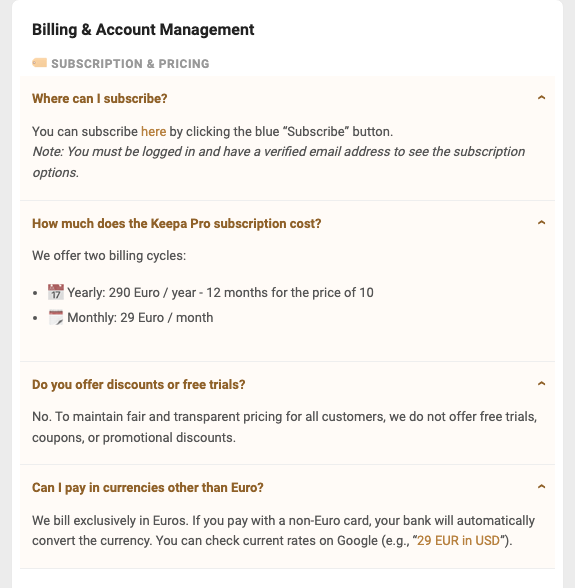
Keepa Pro costs less than any Helium 10 plan, but the currencies differ: Keepa bills only in euros, €29 a month or €290 a year (“12 months for the price of 10”), and Helium 10 bills in US dollars. Keepa’s FAQ also rules out free trials, coupons and promotional discounts. Helium 10’s plan-by-plan prices are on our Helium 10 pricing page.
Correction (10 October 2026): this page previously described Helium 10’s plans as Free, Platinum, Diamond and Enterprise. Helium 10’s pricing page lists only Platinum, Diamond and Enterprise; a limited free account exists, but it is not a plan.
What Keepa does: price, sales-rank and Buy Box history
Keepa’s free features are price-history charts, Deals and price alerts, on keepa.com and in its browser extension, with no account required. Keepa Pro adds what its Pro page calls a “comprehensive data suite”: Product Finder to search and filter millions of products, Advanced Graphs for sales rank, offer counts and rating and review counts, Buy Box Statistics on Buy Box rotation, inventory tracking of current and historical stock for every offer, Top Seller Lists, variation data, the full Deals table, and updated price data for up to 10,000 products you choose.
That makes Keepa a sourcing and validation tool. Before you buy stock, its charts show whether a price has held, how sales rank moved with it and who has been winning the Buy Box. The Keepa pages we checked don’t spell out which chart lines are free beyond price history; Advanced Graphs, with sales rank and offer counts, are listed as a Pro benefit. For other sourcing tools, see our Amazon arbitrage tools roundup.
Winner for price history and sourcing checks: Keepa.
What Helium 10 does that Keepa doesn’t
Helium 10 is built for selling your own products. Black Box, which Helium 10 describes as its tool to “discover profitable products”, and Xray in its Chrome extension estimate demand, revenue and competition. Cerebro and Magnet handle keyword research, Listing Analyzer and Listing Builder work on the listing, and Diamond adds Helium 10 Ads (formerly Adtomic) for PPC campaign management, with a 2% fee on managed ad spend. Keepa’s Pro page lists no keyword, listing or advertising tools. Our overview of Helium 10’s features goes tool by tool.
Check the plan before you buy. Platinum’s keyword research is capped at 100 searches a month, and rank tracking costs extra there (a Keyword Tracker add-on from $19 a month). Diamond ($279 a month billed yearly) includes rank tracking and is the plan you need for AI listing building and Helium 10 Ads. Helium 10’s sales and search-volume figures are estimates from its own models, according to its help center; our explainer on how Helium 10 gets its data has the detail.
Winner for private-label research, keywords and listings: Helium 10.
Where Jungle Scout fits
If your shortlist is Helium 10, Jungle Scout and Keepa, the first two are the real rivals: both are research suites with sales estimates, keyword research and listing tools, and Jungle Scout’s plans start lower ($29 a month billed annually, against $99 for Helium 10 Platinum). Our Helium 10 vs Jungle Scout comparison covers that choice, and our best Amazon seller tools roundup shows where each of the three fits in a full stack. Keepa can sit alongside either one.
Who should choose Keepa, Helium 10 or both
Keepa alone is enough if you:
- buy existing products to resell (online arbitrage or wholesale) and mainly need price and rank history before buying
- want the cheapest paid data: Keepa Pro is €29 a month
- don’t need keyword research, listing tools or PPC management
Helium 10 is worth paying for if you:
- sell your own private-label products and need product ideas, keywords and listings
- want PPC management (Diamond) or Walmart and TikTok Shop support
- want profit, inventory and refund tools in the same account
Use both if you check price history before launching a product and also run keyword, listing and ad work. Keepa Pro adds €29 a month to whichever Helium 10 plan you choose. For the wider field, see our best Amazon product research tools.
Frequently Asked Questions
Is Keepa enough for Amazon sellers?
For arbitrage, wholesale and price checks, often yes: Keepa's price-history charts are free, and Keepa Pro (€29 a month) adds sales-rank graphs, Product Finder, Buy Box statistics and stock tracking. Keepa's Pro page lists no keyword research, listing or advertising tools, so private-label sellers usually need a suite such as Helium 10 as well.
How much does Keepa cost compared with Helium 10?
Keepa Pro costs €29 a month or €290 a year, billed only in euros, and its price-history charts are free. Helium 10's cheapest plan, Platinum, costs $99 a month billed yearly or $129 month to month. Both were checked on 10 October 2026.
Does Keepa or Helium 10 have a free trial?
Neither. Keepa says it offers no free trials, coupons or promotional discounts, but its price-history charts work without an account. Helium 10 has no free trial of its paid plans; it offers a limited free account and a free Chrome extension instead.
Is Helium 10 better than Keepa for product research?
For private-label research, yes: Helium 10's Black Box and Xray estimate sales and revenue, and Cerebro and Magnet cover keywords. Keepa Pro's Product Finder searches and filters millions of products, and its graphs show price and sales-rank history, which suits arbitrage and wholesale sourcing.
Can you use Helium 10 and Keepa together?
Yes. Keepa covers price, sales-rank and Buy Box history before you buy stock, while Helium 10 covers product discovery, keywords, listings and ads. Keepa Pro adds €29 a month to whichever Helium 10 plan you choose.