Best Amazon Product Research Tool in 2026: One Clear Pick, Six Tools Compared
Affiliate disclosure: we may earn a commission if you buy through links on this page. How we make money How we check facts
Jungle Scout is the best Amazon product research tool for most sellers. Its Growth Accelerator plan covers all three research jobs, finding products, validating them and finding suppliers, for $49 a month billed annually or $79 monthly (Jungle Scout’s pricing page, checked 10 October 2026).
Growth Accelerator from $49/mo billed annually · partner rates last confirmed 2 August 2026 Affiliate link
The button goes to Jungle Scout’s partner page, which showed Growth Accelerator at $39 a month billed annually ($470 a year) when we last confirmed it on 2 August 2026. Jungle Scout’s own new-customer offer, the page its help center points new customers to, is cheaper in the first year: $441 for a year of Growth Accelerator, renewing at $588 (checked 10 October 2026). Read the refund note below before you rely on the guarantee for either discounted price.
Helium 10 Platinum costs about twice as much on yearly billing and suits sellers on Walmart too, but Helium 10’s PPC tools need Diamond, at $279 a month.
The reasoning behind the pick: “product research” is three jobs, each fails in a different way, and a tool bought for the wrong one leaves the slow job slow.
How we picked. We compared each tool on the three jobs below using what the vendor’s own pricing table includes at each plan, its published price (checked 10 October 2026) and its documentation. The accuracy section quotes each vendor’s own claims and shows where they conflict. How we test explains the method.
Discovery, validation, sourcing: three jobs under one label
Discovery is finding candidates. You have no product yet and you want a list of things that might work. This is what people mean by an Amazon product finder or product hunting tool: filters over a large catalogue (category, price band, review count, estimated revenue, number of sellers) that turn an unusable number of listings into forty you can look at properly.
Validation is deciding whether a candidate is real. Is the demand steady, or was it one good Q4? Is the first page held by three entrenched sellers, or is it churning? Is there margin left after FBA fees, storage and the advertising you’ll need to get seen? This is the job behind searches for an Amazon product analysis tool, and it’s where the money goes, because discovery tools show you what exists, not what you could take.
Sourcing is whether you can get the thing. For private label that means unit cost, minimum order quantity and lead time against your working capital. For wholesale and arbitrage it means something narrower: is the brand accepting new resellers, is the category gated for your account, and is Amazon itself selling on the listing. Our guide to Amazon arbitrage tools covers the resale side.
Most tools here are strongest at discovery and weakest at sourcing, because discovery is the part a database can solve; Jungle Scout’s Supplier Database is one of the few sourcing features on this page. So the useful question isn’t which tool has the longest feature list. It’s which of the three jobs is slowing you down, and whether you’re researching a product at all. Some sellers are choosing a market, which needs a different database; more on that below.
Amazon product research software compared: six tools
| Tool | Best for | Price checked 10 Oct 2026 |
|---|---|---|
| Jungle Scout | Most sellers: all three jobs | Growth Accelerator $49/mo yearly, $79 monthly |
| Helium 10 | Research plus Walmart and TikTok Shop; PPC on Diamond | Platinum $99/mo yearly, $129 monthly |
| SmartScout | Brands, sellers and wholesale | Basic $29/mo yearly, $49 monthly |
| Data Dive | Validating a shortlist’s keywords | Starter about $32/mo yearly, $39 monthly |
| Product Opportunity Explorer | Amazon’s own demand data | Free in Seller Central |
| Keepa | Price history | Free charts; Keepa Pro €29/mo |
Best Amazon product research tool for most sellers: Jungle Scout
Jungle Scout sells two product lines, so check which one a price refers to. Catalyst is the self-serve product for sellers with up to $1M a year in revenue, and it is the one this page is about. Cobalt is an enterprise platform for $1M+ businesses, sold through a demo with no published price.
Jungle Scout Starter costs $29 a month billed annually ($348 a year) or $49 month to month. Growth Accelerator is $49 a month billed annually ($588) or $79 monthly. Brand Owner is $129 a month billed annually ($1,548) or $149 monthly (Jungle Scout’s pricing page, checked 10 October 2026).
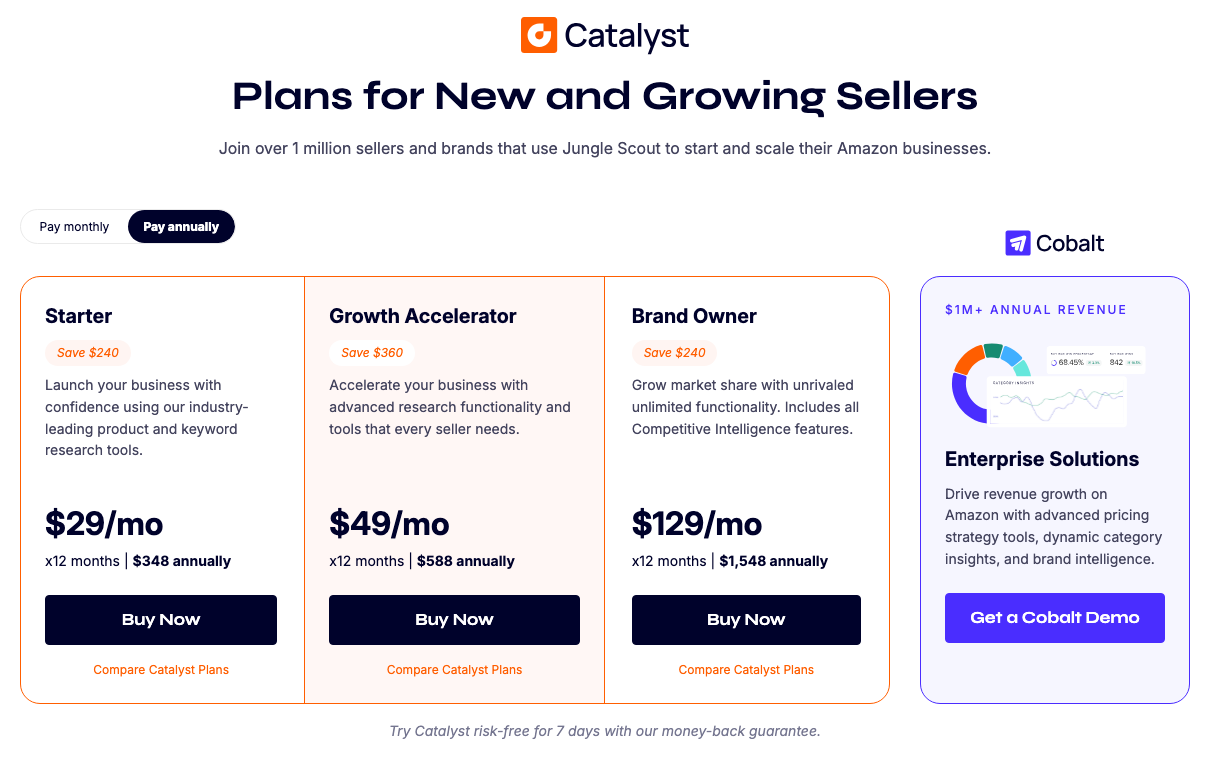
Growth Accelerator is the plan to compare, because Starter is a sampler. Jungle Scout’s comparison table gives:
| What you get | Starter | Growth Accelerator |
|---|---|---|
| Product Database and Opportunity Finder | 100 searches a month each | No cap shown |
| Product Tracker | 50 products, 30 days of history | 150 products, 6 months |
| Keyword Scout | 50 searches a month, 1 month of history | 250 a month, 1 year |
| Supplier Database, exports, listing tools | Not included | Included |
Brand Owner adds 2,000 tracked products, Keyword Scout with no cap shown, two years of keyword history and Competitive Intelligence, with 3 seats; our Amazon keyword research tools guide compares Keyword Scout with Helium 10’s Cerebro and SmartScout’s Rank Maker. Every Catalyst plan includes the browser extension, which its Chrome Web Store listing says shows sales and price history and an Opportunity Score for demand, competition and listing quality on Amazon’s pages.
There is no free trial. New customers on regularly priced plans get a 7-day money-back guarantee; refunds aren’t automatic, so you ask support by chat or email. Jungle Scout’s FAQ excludes “special promotions or trials” from the guarantee, although its own new-customer offer page says you can try it “risk-free for 7 days”; for partner prices, Jungle Scout states nothing. Ask support before you rely on a refund for a discounted purchase.
Who should skip it: sellers who also sell on Walmart or TikTok Shop, since Jungle Scout’s help center says it supports Amazon marketplaces only, and sellers outside the eight marketplaces it fully supports (the US, Canada, Mexico, the UK, France, Germany, Italy and Spain). Our Jungle Scout pricing guide has every plan limit, and Helium 10 vs Jungle Scout is the head-to-head.
Best all-in-one alternative: Helium 10
Helium 10 is the broader suite, and its research tools are only part of what you pay for. The research path runs from Black Box for product discovery (the help center lists 250 uses a day on Platinum) to Xray in the Chrome extension, which overlays sales, revenue and pricing on Amazon and Walmart search pages, and Product Launchpad for organizing research. The extension’s Chrome Web Store listing also describes a Supplier Finder that matches products to Alibaba suppliers.
The catch is the plan limits. Helium 10 Platinum costs $99 a month billed yearly or $129 monthly, and its pricing table gives it 100 keyword searches a month and no rank tracking. Diamond, at $279 a month billed yearly, lifts those limits and adds Helium 10 Ads (formerly Adtomic) (Helium 10’s pricing page, checked 10 October 2026). Helium 10 no longer sells a Starter plan, and its pricing page lists no free plan.
Where Helium 10 is clearly ahead is coverage: its help center lists 21 Amazon marketplaces, and it supports Walmart and TikTok Shop as well.
Who should skip it: research-only budgets, because Jungle Scout’s Growth Accelerator does that job for about half the yearly price, and sellers who haven’t launched, who should start with the free tools below. Our Helium 10 pricing guide has each plan’s limits. Helium 10 and Jungle Scout both now sell AI assistants on top of this data; our AI tools guide covers what they do.
Best Amazon market research tool: SmartScout
“Amazon market research tool” gets lumped in with product research, but they are different starting points that need different databases.
SmartScout’s homepage puts the difference this way: product-research tools “are built for product research”, while SmartScout “models the whole marketplace, brands, sellers, and subcategories, not just the products inside it” (smartscout.com, checked 10 October 2026). If your question is which subcategory is worth entering, who already owns a space, or which brands sell through third-party sellers, a product-first tool makes you build the answer one ASIN at a time. SmartScout’s Brands tool, by its own description, shows a brand’s monthly revenue, the sellers carrying it (including unauthorized resellers) and its year-over-year growth.
Wholesale is the clearest case, and the plan matters. SmartScout Basic costs $29 a month billed yearly, or $49 month to month. Essentials is $99 billed yearly ($119 monthly) and Business is $239 billed yearly ($299 monthly). Basic covers product-level data and the Search Terms Database; the Brands Database starts at Essentials, and the Sellers Database and Seller Map at Business. SmartScout’s homepage FAQ says seller search starts at Essentials, but its pricing table, which we follow, says Business. There is no free trial; each self-serve plan carries a 7-day money-back guarantee.
Correction (10 October 2026): an earlier version of this page put the Brands Database on Basic and the Sellers Database on Essentials, and quoted SmartScout’s prices from before its repricing (Basic was previously $29 a month on monthly billing).
Our SmartScout wholesale workflow walks the sourcing process, SmartScout pricing has the full tier map, and Amazon market intelligence tools puts SmartScout against the alternatives.
Who should skip it: private-label sellers with one or two products in a niche they already know. Market mapping helps you choose between markets; if you’ve already chosen, you’re paying for a map of the country you live in.
Best validation layer: Data Dive
Most sellers don’t need Data Dive at the discovery stage. It earns its place once you have a shortlist and need to know which keywords the competitors rank for, and how strongly, before you commit to inventory. A “Dive” builds a Master Keyword List from a set of competitors, with each one’s organic and sponsored rank, search volume and a relevancy score, and Rank Radar tracks keyword rank daily alongside PPC data (Data Dive help center).
Data Dive Starter is $39 a month, or about $32 a month billed yearly; Standard is $149 or $124; Enterprise is $490 or $408 (Data Dive’s pricing page, checked 10 October 2026). Data Dive doesn’t print yearly totals, and it offers no free trial or money-back guarantee. Starter, labelled “For Light Research”, covers 100 Dive ASINs.
Correction (10 October 2026): we previously listed Data Dive yearly totals of $384, $1,488 and $4,896. Data Dive doesn’t display yearly totals; those figures were our own arithmetic.
Who should skip it: sellers with fewer than about five listings, or who write a listing twice a year (our rule of thumb). The wider listing optimization tools comparison covers the alternatives.
Best free Amazon product analysis: Product Opportunity Explorer and Keepa
Amazon Product Opportunity Explorer sits in Seller Central under Growth and uses Amazon’s own data. Amazon says it “primarily categorizes products within niches, which represent specific customer needs”, built by grouping search terms by the products customers view or buy afterwards, and that it surfaces unmet-demand opportunities, “collections of similar search terms that have lower conversion rates than the benchmark” (Amazon). You can filter by demand and purchasing behaviour, competition and saturation, search terms and volume, customer reviews and return activity. Use it as a reality check on a shortlist: the numbers come from Amazon, not from a model. Our Amazon search analytics tools guide and Brand Analytics walkthrough cover the rest of Amazon’s own reporting.
Keepa’s price-history charts are free in its browser extension and on keepa.com. Before you commit to a product, the chart shows whether the price has held steady or been repeatedly discounted, which no discovery tool’s snapshot tells you. Keepa Pro, which adds sales-rank graphs, Buy Box statistics and the Product Finder, costs €29 a month or €290 a year, billed only in euros (Keepa, checked 10 October 2026). Correction (10 October 2026): we previously wrote that Keepa doesn’t publish this price.
How accurate are these estimates?
This should decide how you use every tool above.
No third-party tool sees Amazon’s sales data. Every “estimated monthly sales” figure is a model built from Best Sellers Rank and other public signals. Helium 10’s help center says so directly: apart from tools that read your own account through Amazon’s API, its sales estimates, search volumes and rank figures are its own estimates, produced by models from data it collects daily (Helium 10 help center).
The vendors’ accuracy claims are their own, and they contradict each other:
- Helium 10’s November 2024 study of 29,906 products, using July 2024 sales, gives Helium 10 89.59% accuracy and Jungle Scout 60.00%. Helium 10 notes that 59% of the products had no Jungle Scout estimate at all (Helium 10).
- Jungle Scout’s comparison page, dated March 2024, says Jungle Scout is 84.1% accurate and Helium 10 74% (Jungle Scout). Both figures come from Jungle Scout’s own case study published on 29 May 2019, which the article cites as proof. That study describes its method, comparing each tool’s estimates with sales data sellers shared and ranking tools by median error, but the numbers are seven years old.
- SmartScout’s founder writes that its “analysis shows that we are within 80-90% accuracy on most brands and products”, and that SmartScout tracks the 30 million products “that actually generate revenue”, not all 500 million (SmartScout).
None of these is independent, and each vendor wins its own test. Our explainer on how Helium 10 gets its data goes further. In practice:
- Calibrate before you trust. Check the tool against a category you already know: are the sellers you know about there, and are the revenue figures in the right range?
- Use estimates for ranking, not arithmetic. A model’s error band is fine for deciding which 20 of 200 candidates deserve an hour each. It isn’t fine as the input to a five-figure purchase order.
- Cross-check the finalists with Keepa’s price history, Product Opportunity Explorer and, if you have Brand Registry, Search Query Performance for the categories you already sell in.
Which stack fits which seller
| Seller | Stack | Why |
|---|---|---|
| First product | Jungle Scout Growth Accelerator + Keepa’s free charts | All three research jobs, plus a free price-history check |
| Growing private label | Helium 10 Diamond + Keepa | Research, keyword tracking and PPC in one login |
| Wholesale or reseller | SmartScout Essentials or Business + Keepa | Brand and seller data, plus price history |
| Agency or portfolio | SmartScout + Helium 10 + Data Dive | Market data, execution and keyword validation |
When one tool is enough
Most sellers overbuy. Some thresholds:
- One suite is enough until a specific job repeatedly outgrows it. If you’re still choosing your first or second product, buy one subscription and spend the difference on inventory.
- Add market intelligence when you’re choosing between categories or brands rather than between products. That is a different database, not a better version of the one you have.
- Add a validation specialist when you’re optimizing at volume and keyword data has become the bottleneck.
- Add a profit tracker before anything else once you have real sales. Suites estimate your margin; your settlement reports know it. Our best Amazon seller tools hub covers profit trackers and the rest of the stack.
Frequently Asked Questions
What is the best Amazon product research tool?
Jungle Scout, on its Growth Accelerator plan, for most sellers: it covers finding products, validating them and finding suppliers for $49 a month billed annually or $79 monthly (checked 10 October 2026). Helium 10 is the broader suite if you also sell on Walmart or TikTok Shop, but its PPC management needs Diamond, at $279 a month billed yearly. SmartScout is better if you research brands and sellers rather than products.
What is the cheapest Amazon product research software?
Jungle Scout Starter and SmartScout Basic both cost $29 a month billed yearly, or $49 month to month (checked 10 October 2026). Starter caps Product Database searches at 100 a month and keyword searches at 50, and Basic covers product data but not brand or seller data. Amazon's Product Opportunity Explorer and Keepa's price-history charts are free.
How accurate are Amazon sales estimates?
No third-party tool sees Amazon's sales data, so every estimate is modelled from Best Sellers Rank and related signals. Each vendor's own study puts itself ahead: Helium 10's 2024 study gives Helium 10 89.59% accuracy and Jungle Scout 60%, while Jungle Scout's comparison gives Jungle Scout 84.1% and Helium 10 74%, figures from its own 2019 case study. Use estimates to rank a shortlist, not to size a purchase order.
What is the difference between a product research tool and a market research tool?
Product research starts from a product or keyword and works outward; market research starts from a category, brand or seller and works down. SmartScout indexes brands, sellers and subcategories, which suits wholesale and category selection. Jungle Scout and Helium 10 are built around products and keywords, which suits private label.
Is there a free Amazon product research tool?
Yes. Amazon's Product Opportunity Explorer is free inside Seller Central and reports niche demand, search volume and return activity from Amazon's own data. Keepa's price-history charts are free, and SmartScout's Chrome extension gives 100 free full-feature uses a month.
Which Amazon product research tool is best for wholesale?
SmartScout, because wholesale starts from brands and sellers rather than products. Its Brands Database starts on Essentials, $99 a month billed yearly, and its Sellers Database and Seller Map on Business, $239 a month billed yearly (checked 10 October 2026). Basic alone covers product-level data only.