SmartScout Ad Spy Review: Strong PPC Research, Enterprise-Only Access

SmartScout Ad Spy is a genuinely useful Amazon PPC competitor research tool with two catches nobody else will tell you about: it sits on the Enterprise plan alone, and it never shows you a CPC or a dollar of ad spend. Both facts should change whether you read any further.
Ad Spy is Enterprise-only · quoted per account
We checked SmartScout’s live pricing comparison table on 2 August 2026. The row is called “Search Terms Ad Spy”, and the tick appears in the Enterprise column only — not Business at $187, not Essentials at $97. Since Enterprise is quoted per account rather than published, the SmartScout coupon code that takes 25% off Basic, Essentials and Business is of no use to you here. If you were hoping to buy Ad Spy for a listed monthly price, you cannot.
| Question | Short answer |
|---|---|
| What it does | Reverse-engineers a competitor brand’s paid search strategy from observed ad visibility |
| Cheapest plan that includes it | Enterprise — custom quote, no list price |
| Does it show ad spend or CPC? | No. Estimated searches and win-rate percentages only |
| Ad formats covered | Sponsored Products, Sponsored Brands, Sponsored Video |
| Export | Excel |
| Best for | Agencies, aggregators and brands already in an Enterprise contract |
| Wrong for | Almost every self-serve seller — see best Amazon PPC tools instead |
What SmartScout Ad Spy actually does
Every Amazon seller running ads is bidding blind. You know your own search-term report. You do not know which terms your competitor is buying, how aggressively, or whether the term you just lost was one they defend or one they stumbled into.
Ad Spy is SmartScout’s attempt to close that gap. In their framing: “With AdSpy, you’ll be able to see the metrics behind all of your competitors’ paid search terms and discover the best keywords to target within your own Amazon PPC advertising campaign.” The product is organised brand-first, which is consistent with the rest of the platform — SmartScout says “we’ve structured AdSpy so you can first see data from a brand perspective”, then lets you drill into individual terms and products.
That brand-first orientation is the real design decision. Most keyword tools start with a term and tell you about demand. Ad Spy starts with a competitor and tells you about behaviour.
What Ad Spy looks like if you are not on Enterprise
This is the part no other page reports, because it requires actually opening the tool on a lower plan.
Ad Spy is not hidden behind a locked door. On a Business account it appears as a tab inside any product view and it does return results — we opened it against ASIN B0CJ1B6D6S (Scrub Daddy) and it reported 269 paid search terms. You can read the first five of them: scrub daddy mop, kitchen sponges for washing dishes, happy sponge, oxo brite, sold and shipped by amazon.
The remaining 264 are blurred out.
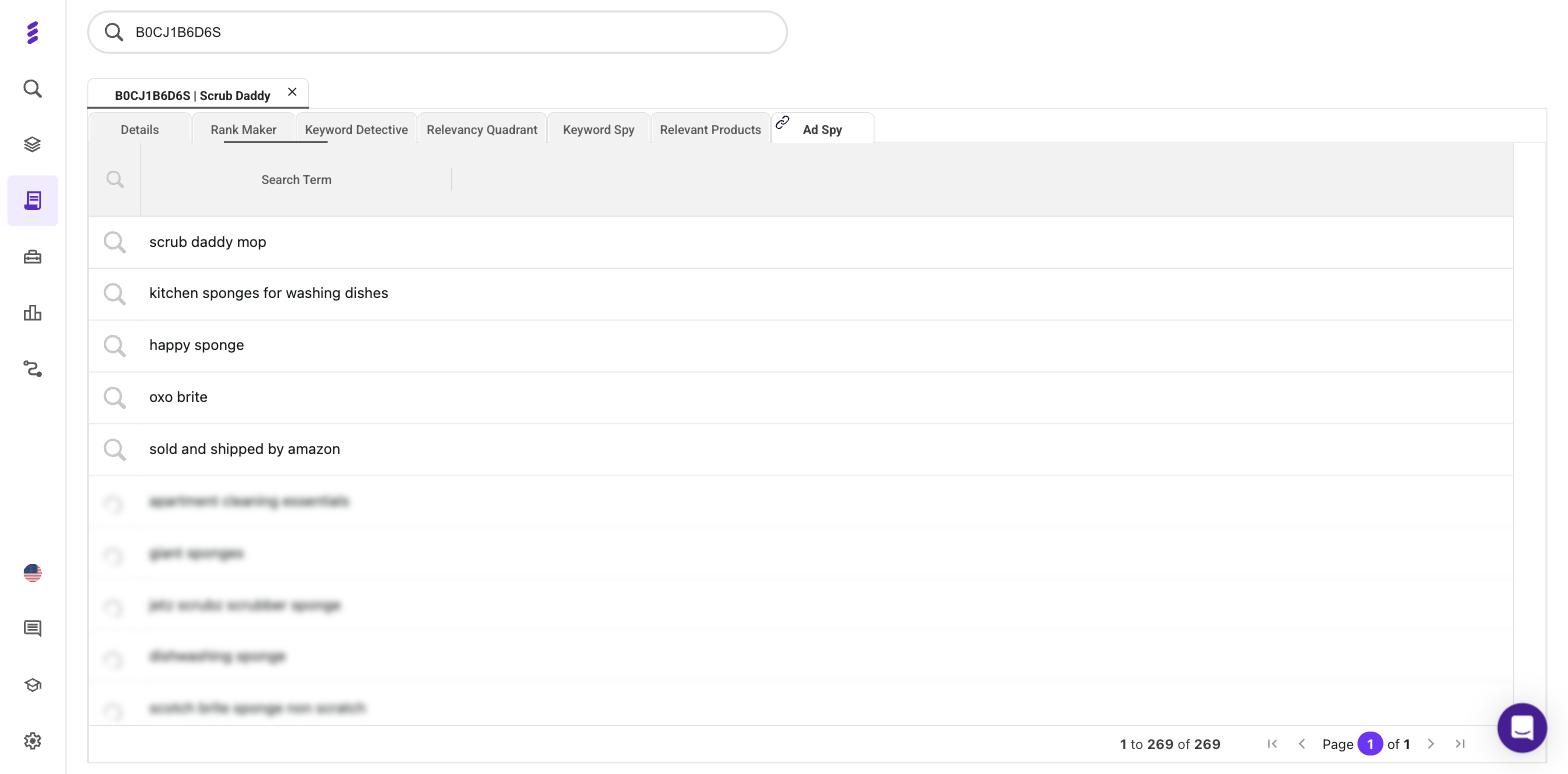
That is a deliberate upsell design, and it is more useful than a hard lock: you learn how much paid-keyword data exists for a competitor before deciding whether Enterprise is worth a sales call. It also means the honest answer to “is Ad Spy included in my plan?” is partly — you get the count and a five-row taste, and the actual tool is Enterprise.
Verified on a live SmartScout Business account, 2 August 2026.
A note on the name
SmartScout calls this tool three different things, which is worth knowing if you are searching for it:
- “Amazon PPC Competitor Research AdSpy” — the H1 on the product page
- “Ad Spy” — the site navigation
- “Search Terms Ad Spy” — the row in the pricing comparison table
So “SmartScout AdSpy” and “SmartScout Ad Spy” are the same product. The pricing-matrix name is the one that matters commercially, because it is the only place on their site that gives a real per-tier answer.
The six brand-level fields, and what each one is for
Ad Spy surfaces six fields at brand level. Here is what each tells you and, more usefully, the decision it supports.
| Field | What it reports | The decision it supports |
|---|---|---|
| Estimated Searches | Modelled search demand behind the term | Whether the term is worth contesting at all. A win rate on a term nobody searches is a vanity number |
| Sponsored Products | The count of sponsored product placements associated with the brand | Breadth of the campaign — is this a focused defence of a few terms or a wide net? |
| Sponsored Brand Win Rate | Share of observed opportunities where the brand took a Sponsored Brands headline slot | Whether the incumbent is investing in top-of-page brand real estate, which is expensive to displace |
| Sponsored Video Win Rate | The same, for Sponsored Video placements | Where video inventory is under-contested. This is the field most likely to show a gap |
| Top Spot Win Rate | How often the brand takes the single best sponsored position | Commitment. A high top-spot rate on a high-volume term means someone is bidding to hold it |
| Top Group Win Rate | How often the brand appears anywhere in the leading cluster of sponsored placements | Consistency of presence rather than dominance — useful for spotting always-on campaigns |
Two honest caveats about that table.
First, SmartScout does not publish formal definitions for these fields, so the “what it reports” column is a careful reading of the field names against how the tool is described, not a quotation of documentation.
Second, and more importantly: a win rate is a percentage without a published denominator. SmartScout does not say how many observations sit behind a rate, over what window, or how frequently the SERP is sampled. That is not a reason to distrust the data, but it does dictate how to use it. Win rates are dependable for ranking competitors against one another on the same term. They are weak as absolute figures, and you should not put “our rival wins 63% of top spots” into a board deck as though it were measured.
Formats and export
Ad Spy covers Sponsored Products, Sponsored Brands and Sponsored Video. Splitting win rates by format is the most practically useful thing in the tool, because ad formats are bought separately and a brand’s coverage is rarely even across all three.
Export is to Excel — SmartScout’s wording is “export your filtered data directly into an Excel spreadsheet with just a couple of clicks”. Given that Ad Spy contains no cost data, the export is not a convenience feature. It is where the actual analysis starts, because the numbers only become decisions once you join them to your own reports.
Estimated, not measured — read this part carefully
This is where most pages about this tool go wrong, so let us be exact.
SmartScout’s own answer to “how accurate is Amazon PPC competitor data in AdSpy?” is:
“AdSpy uses large-scale Amazon SERP data to estimate paid keyword activity and win rates. While Amazon does not publish exact ad spend, AdSpy provides reliable directional insights based on real ad visibility.”
Three things follow from that sentence, and all three matter.
The input is search results, not ad accounts. Nobody hands SmartScout a competitor’s campaign data. The method is repeated observation of what appears in sponsored slots, aggregated upward. That is a legitimate technique — it is roughly how every competitive-ad-intelligence product outside a walled garden works — but it means every figure is inferred from visibility.
“Directional” is SmartScout’s own word, not a critic’s. They are telling you the data supports comparative judgements, not precise ones. Use it to decide which terms a rival is defending hardest. Do not use it to decide that a rival’s win rate moved from 41% to 44% last month.
Sampling introduces blind spots that do not announce themselves. Ads vary by time of day, placement, shopper and device; a crawl catches a slice. Thin sponsored inventory, dayparted campaigns and short burst promotions are where an observational estimate is least reliable — and nothing in the interface flags which rows those are.
None of this makes Ad Spy bad. It makes it evidence, which is worth having when the alternative is guessing. Weight it accordingly next to your own account data, which is measured.
What Ad Spy does not give you: CPC and ad spend
Ad Spy contains no cost-per-click values and no dollar ad-spend figures. It gives estimated searches and win-rate percentages. That is the complete cost picture: there isn’t one.
This is worth stating flatly because the competing pages on this topic get it wrong. At least one well-ranked affiliate article about SmartScout Ad Spy lists “ad spend estimates by keyword and brand level” and “CPC estimates” among its outputs. Neither is a thing Ad Spy produces.
The confusion has an obvious source. “Competitor Ad Spend” is a genuine line item on SmartScout’s Enterprise plan card — it sits alongside Competitor Ad Data, the Historical Data Suite, the API and the Data Lake. It is a separate entry in a separate list. Seeing “Competitor Ad Spend” on the Enterprise card and assuming it describes Ad Spy is an easy mistake, and it is the mistake that produces the CPC claims.
If you need cost figures, they come from elsewhere: your own campaign reports for what you actually pay, or SmartScout’s Estimated PPC Bid, which is a data point inside Rank Maker — a tool that starts on Essentials and is therefore considerably easier to buy.
What you would actually do with win-rate data
Here is a workflow that uses Ad Spy for what it can support rather than what you wish it did.
1. Start with the brand, not the keyword. Pull the Ad Spy table for a competitor you already know matters. The brand-first structure makes this the natural entry point.
2. Filter on Estimated Searches first. Win rates on low-demand terms are noise. Cut the table to terms with real volume behind them before you look at any percentage.
3. Read Top Spot Win Rate as a commitment signal. High demand plus a high top-spot rate means a term someone is paying to hold, and entering that auction means bidding against a demonstrated willingness to defend. That is not a reason to avoid it — it is a reason to enter with a budget and an expectation, rather than a $0.60 default bid and hope.
4. Hunt for the format gaps. Compare Sponsored Video Win Rate against Sponsored Brand and Sponsored Products coverage on the same term. A brand winning Sponsored Products consistently but showing little video presence is leaving inventory uncontested. Video is more work to produce, which is why fewer sellers run it and why the gap persists.
5. Check who is bidding on your brand name. SmartScout says AdSpy “identifies when other brands bid on your branded keywords”. Branded-term defence is a different budget conversation from acquisition, and it is one of the few Ad Spy findings that translates into action the same day.
6. Export, then join. Ad Spy has no cost data, so the export is only half the picture. Bring it into Excel next to your own search-term report and you can put competitor visibility beside your real ACOS on the same term. That join — observed rival behaviour against your measured cost — is the analysis worth paying for.
7. Feed the winners back into organic. SmartScout makes a fair point that paid terms often reveal high-converting language worth using in listings and backend keywords. If you also run Keyword Detective or the Search Terms Database, the paid list is a good filter for which organic terms deserve effort.
Who it is for — and who should not buy it
Ad Spy makes sense if: you are an agency managing several brands’ Amazon advertising, an aggregator assessing an acquisition target’s paid moat, or a brand with enough spend that a percentage point of ACOS is worth a research contract. In all three cases you are likely already in an Enterprise conversation for the API, the Data Lake or the historical suite — and Ad Spy comes along with that.
Most sellers should not buy SmartScout for Ad Spy, and we would rather say so. The Enterprise bar is the whole argument. There is no published price, no self-serve checkout, no coupon, and no way to test the tool for a month to see whether it changes a decision. You will be in a sales process before you find out what it costs. For a seller running $5,000 a month in ads, that is a poor trade against software you can buy this afternoon.
It is also the second SmartScout tool this happens with. Share of Voice reads like a mid-tier competitive metric and is likewise Enterprise-only. If competitive visibility is your reason for looking at SmartScout at all, check the tier before you get attached — our SmartScout pricing guide has the full breakdown, and the full SmartScout review covers where the platform genuinely earns its money.
Pros
- Answers a question almost nothing else can: which terms a rival actually defends
- Win rates split by ad format, which exposes uncontested video inventory
- Brand-first structure matches how competitive research actually starts
- Flags competitors bidding on your branded terms
- Excel export makes joining it to your own account data straightforward
Cons
- Enterprise-only — no list price, no coupon, no self-serve path
- No CPC and no dollar ad spend, despite what several competing pages claim
- Win rates are percentages with no published denominator or sampling window
- Estimated from SERP observation, so dayparted and burst campaigns are blind spots
- SmartScout's own FAQ implies broader plan availability than the pricing table gives
If Enterprise is out of reach
Be clear about what you are replacing. Ad Spy is an outside-in observation tool. Most affordable PPC software is an inside-out management tool, working from your own connected account. They are not substitutes, and any page telling you otherwise is selling something.
That said, here is the honest ranking of what to do instead.
Buy PPC management, not PPC espionage. For nearly every seller, the money is in running your own campaigns better rather than in modelling someone else’s. Our roundup of the best Amazon PPC tools compares the field by seller size and ad complexity, and Helium 10 Adtomic is the pragmatic default if you already run Helium 10 — though its automation requires Diamond rather than Platinum, and Helium 10’s public pricing adds a 2% fee on ad spend managed through it, which is the number to check before committing.
Stay inside SmartScout, one tier down. If you specifically want competitive keyword intelligence without an Enterprise contract, Competitor Keywords and Rank Maker both arrive at Essentials, and Rank Maker’s Estimated PPC Bid is the closest thing SmartScout offers to a cost signal at a published price. Neither gives you win rates, but both cost $97 a month rather than a quote.
Use Amazon’s own data harder. Your search-term report tells you which terms convert, at what cost, with no estimation involved — and most accounts have not exhausted it. That is an unsatisfying answer for anyone shopping for an Amazon competitor ad spy tool, but it is usually the correct one.
What to read next
- SmartScout review — whether the platform is worth it at all
- SmartScout pricing — every tier, and which tools each one unlocks
- SmartScout coupon code — 25% off for three months on Basic, Essentials and Business, but not Enterprise
- Best Amazon PPC tools — the practical alternative for most sellers
- SmartScout Keyword Detective review and the Search Terms Database review for the keyword side of the stack
Frequently Asked Questions
Which SmartScout plan includes Ad Spy?
Enterprise, and only Enterprise. SmartScout's pricing comparison table lists the feature as 'Search Terms Ad Spy' and ticks it for the Enterprise column alone — not Business, not Essentials, not Basic. We checked the live table on 2 August 2026. SmartScout's own AdSpy FAQ says it is 'included in SmartScout plans, with access levels depending on your subscription tier', which reads far more generous than the matrix actually is. Because Enterprise is quoted per account rather than published, the 25% partner coupon — which applies to Basic, Essentials and Business — cannot help you here.
Does SmartScout Ad Spy show competitors' actual ad spend or CPC?
No. Ad Spy reports estimated searches and win-rate percentages. It does not contain cost-per-click values or dollar ad spend, and Amazon does not publish that data to third parties. 'Competitor Ad Spend' is a separate line item on SmartScout's Enterprise plan card, not something Ad Spy delivers. Several affiliate pages describing Ad Spy claim it shows CPC estimates and spend per keyword — that is a conflation of two different products.
How does SmartScout Ad Spy produce its estimates?
By observing Amazon search results at scale. SmartScout's own wording is: 'AdSpy uses large-scale Amazon SERP data to estimate paid keyword activity and win rates. While Amazon does not publish exact ad spend, AdSpy provides reliable directional insights based on real ad visibility.' In practice that means repeated sampling of what appears in sponsored slots for a term, aggregated to the brand. It is observational data about visibility, not reported data from anyone's ad account.
What does a win rate actually mean in Ad Spy?
It is the share of observed sponsored opportunities on which a brand took the placement — expressed as a percentage across Sponsored Brands, Sponsored Video, the top spot, and the top group. SmartScout does not publish the denominator: how many observations, over what window, at what sampling frequency. Treat win rates as reliable for ranking competitors against each other, and weak as absolute figures.
Is SmartScout Ad Spy better than Helium 10's PPC tools?
They do opposite jobs. Helium 10's advertising layer, Adtomic, manages your own campaigns using your own connected account data — real bids, real spend, real ACOS. Ad Spy observes competitors from outside and reports what it can see, with no cost data at all. If you need to run ads better, Helium 10 is the practical buy — but its ad automation sits on Diamond ($279/month billed yearly, $359 monthly), not Platinum, which only carries the Ads academy training. If you need to understand a rival's paid strategy and you already hold an Enterprise contract, Ad Spy answers a question Helium 10 cannot.
Which Amazon ad formats does Ad Spy cover?
Sponsored Products, Sponsored Brands and Sponsored Video. The win-rate fields are split by format, which is the most useful thing about them — a brand can dominate Sponsored Products on a term while barely contesting video, and that gap is visible in the data.
Can I export SmartScout Ad Spy data?
Yes. SmartScout says you can 'export your filtered data directly into an Excel spreadsheet with just a couple of clicks'. That matters more than it sounds, because Ad Spy has no cost data — the analysis that makes it useful happens after you join the export against your own search-term reports.